FYI Your Body Is TMI. Emancipatory Musicals and Cringe at the 2026 Fringe
I.
It is August 2013, and a relatively unknown twenty-eight-year-old London actress named Phoebe Waller-Bridge is heading to the Edinburgh Festival Fringe with her friend, director Vicky Jones, and her own one-woman show, Fleabag. She is still finishing the script on the train to Edinburgh; their accommodation is decidedly makeshift, and the creators are given a mere three hours for their technical rehearsal, in the middle of the night. And yet, lo and behold, the investment of time, money and energy pays off. Audiences take notice of the show, performed in a small underground venue seating sixty people in a late-evening time slot. Fleabag receives excellent reviews and eventually wins several awards, including the prestigious Fringe First and a Best Solo Performer award. It is not long before BBC producers come calling, and the intimate one-woman show gives rise to the now-famous comedy series. Phoebe Waller-Bridge is catapulted to the uppermost ranks of the theatre and film industries.
If I am to write about this year’s Edinburgh Festival Fringe and its emancipatory reinterpretations of classic stories, I might as well begin with this “classic story” of Phoebe Waller-Bridge. Fairytale-like though it may sound, at least to all those artists who arrive at the festival every year nurturing dreams of “making it”, the story is entirely true and by no means unique. In the 1960s there were the Monty Pythons, whose careers began at the Fringe; in the 1970s Rowan Atkinson attracted the attention of producers while appearing here in an Oxford student revue alongside screenwriter Richard Curtis, with whom he would later create the cult series Blackadder and Mr Bean. More recently, there was Richard Gadd, whose famous Netflix series Baby Reindeer was based on nothing other than his one-man show of the same name, staged at the Fringe a few years earlier.
The festival is known precisely for functioning as a gargantuan marketplace, where producers and talent scouts from leading theatres and the biggest streaming platforms converge every August, and where the chances of “being seen” are considerable. At the same time, the festival operates under an open-access policy: there is no artistic board curating its programme. Anyone who can secure a venue and pay the rent can take part, and therein often lies the rub, since the sums involved run into thousands of pounds.
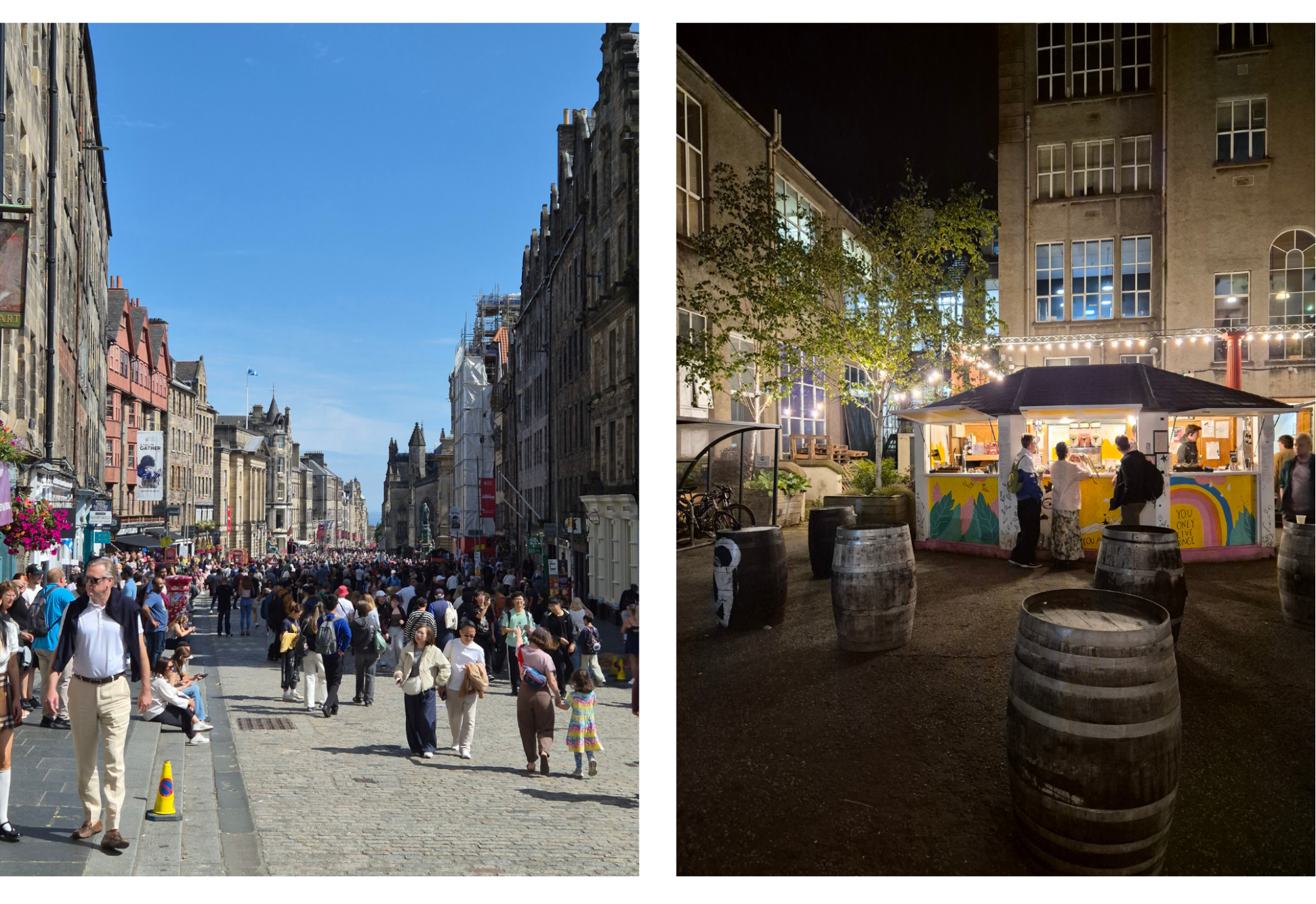
Performances take place throughout Edinburgh’s wider city centre, not only in conventional theatres and cultural centres but also in the streets, pubs, temporarily erected tents and big tops, and University of Edinburgh classrooms. Among my most beautiful spatial experiences during this year’s visit was Summerhall, a sprawling Edwardian building that once housed a veterinary school and now operates as a large cultural centre with numerous performance spaces (its main hall used to be a dissection room). Among the most bizarre, by contrast, were a theatre performance in a sauna and an adults-only magic show in a university lecture theatre, where we sat at desks and could take notes while magicians and their assistants (all of them men!) performed their, well, tricks around us.
To give some idea of the scale, this year’s official programme featured a total of 3,649 shows playing in repertory, while more than two thousand performances were reportedly staged in 258 venues in the course of a single day. There is a charming irony here, given that the festival originated in 1947 as a peripheral rebellion against the grand Edinburgh International Festival, to which several amateur and independent companies had not been invited. Hence the name itself, fringe, meaning the edge or periphery. “The original festival”, as one of its posters jokingly proclaimed this year, is still held to this day. The Fringe, however, has since outgrown it many times over and transformed itself into an event commonly celebrated as the largest arts festival in the world.
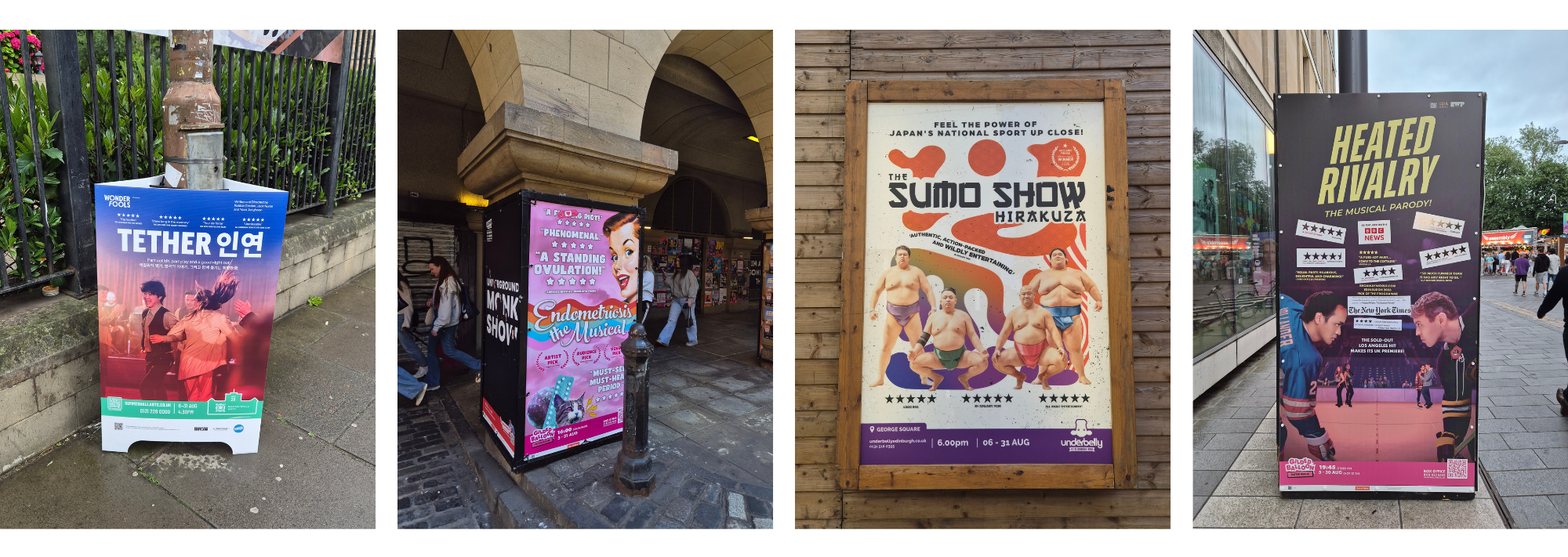
British, and more broadly Anglophone, work dominates the Fringe. Alongside British productions, American, Australian and Canadian projects were particularly well represented this year. I was also fortunate enough to see, for example, the remarkable Tether, a Scottish–South Korean co-production that uses a fictional story of two people meeting and parting, unfolding across most of the twentieth century, to chart the histories of the two countries and their mutual relations. (Those relations turned out to be more intricate than one might initially imagine. I had not known, for example, that the Korean national anthem was sung for decades to the melody of the well-known Scottish folk song Auld Lang Syne, which Western missionaries had brought to Korea, or that the anthem with its Scottish melody served as a patriotic symbol of resistance during the Japanese occupation.) Built around Scottish and South Korean songs and dances, with audience participation initiated in an extremely relaxed and organic way, and accompanied by an excellent live band that included a musician playing the long Korean zither known as the komungo, the production itself happened to have originated at the Fringe two years earlier, when its creators were performing here separately. The festival ideally serves precisely this kind of purpose as well: facilitating artistic encounters that then develop into further collaboration.
The festival programme was extraordinarily varied overall. Alongside more conventionally conceived theatrical or performance work, it offered countless projects of a kind one would be unlikely to encounter anywhere else. As a rule, you can never know in advance which selected experiment will turn out to be an utter monstrosity and which will be brilliant. You simply have to take the risk and give it a try. Among the gambles in my own selection were the Japanese The Sumo Show HIRAKUZA, a lecture-performance created entirely in and about Excel, Excel Comedy and Mathem-antics, theatre in an actual hot sauna, Bubble Schmeisis, and a comedically framed competition in assembling IKEA furniture, IKEA WARS. The latter two projects were rather disappointing. IKEA WARS did not manage to develop its one-off premise to any significant degree and was additionally weakened by the repetitive delivery of its central comedian-host. The sauna itself was pleasant. The uncritically affirmative Israeli national framing of the performer’s storytelling was rather less so in the context of current events, and also quite surprising given the broadly liberal and socially critical orientation of the other productions I attended.
The Excel stand-up, by contrast, delivered superbly nerdy, cringey humour full of jokes about excels, incels and “a piece of sheet”, fun facts from the world of Excel, and several fantastic magic tricks performed entirely within Excel. Out of it also emerged, rather unexpectedly, a sincere personal account of the performer’s own queer experience. The Sumo Show remains in the memory as a peculiarly bizarre experience. It was clearly a cultural export with a pronounced educational and popularising dimension, but despite a certain straightforwardness, the information it conveyed was enriching for someone like me, entirely untouched by sumo, and the interactions between the wrestlers entertainingly oscillated between a solemn presentation of Japan’s national sport and mischievous silliness, while warmly engaging both adult and child audiences.
A comedic framework was, after all, employed by almost all of the twenty-five projects I attended and, judging by the nature of their promotion, by the overwhelming majority of the 3,649 shows on offer. This included a Kafkaesque variation about an innocent person imprisoned by a totalitarian state, which Yulia Navalnaya was supposed to attend as a guest before cancelling at the last moment (reportedly for security reasons), as well as a thriller about a tradwife influencer being held in an attic by her abusive husband. Creative works that took violence, illness, trauma or political catastrophe as their subject matter, in other words, thoroughly dark material, approached it through the language of comedy, whether as musicals, stand-up or other comedic forms. Humour became a crucial vehicle for their message. This feature has long been associated with British culture in general, but it is perhaps heightened further at the Fringe, where the struggle for audience attention is merciless and the promise of entertainment makes it considerably easier to ensnare spectators during a twenty-second street-flyering pitch. The successful Fringe hits of recent years, such as Fleabag and Baby Reindeer, would also seem to support this observation: both are, in fact, extremely dark works, yet both communicate with their audiences specifically through humour.
II.
At this year’s festival, alongside the various Fringe oddities, I set myself a dramaturgical strand to follow, consisting of projects that addressed questions of gender, specifically female and, in some cases, queer identity and embodiment in the context of social expectations, and did so through musical or musically parodic forms. There were plenty of such projects in the programme, and many of those I saw were united by a desire to rewrite a “classic story”, whether a traditional fictional narrative (fairytale or mythological), or a social narrative connected with expectations concerning the position of women and queer people.
One notable Fringe tendency, popular with both children and adult audiences, was the retelling of fairytales from the perspective of secondary or marginalised characters. This is a trend that has been present in international, and to some extent Czech, theatre, film and popular culture more generally for several years now. One need only think of the successful film Wicked, released two years ago, which retells The Wizard of Oz from the perspective of the “Wicked Witch”. The musical Bliss attracted the greatest attention at the Fringe. Billed as “the biggest new musical at this year’s festival” (albeit one that originally premiered in the United States in 2019) and selected as one of The New York Times’ picks, it was staged in the festival’s largest venue, the 750-seat Pleasance Courtyard. The story of four princesses striving to find their place in the world and to be allowed to exist as they truly are possessed undeniable energy and featured talented vocal performances. Nevertheless, it suffered at times from narrative shorthand and from several moments that were problematic precisely in light of its ambition to be a feminist musical. These included the exculpatory portrayal of the father who locks the princesses in a tower as a foolish but fundamentally decent man, and the amount of space devoted to depicting the restrictive conservative world at the expense of the princesses’ journey towards discovery and transformation.
A more sophisticated and understated approach was offered by the more intimate, small-scale musical Apparently Ugly: A Stepsister Story, devoted to Cinderella’s stepsisters after Cinderella’s wedding and their attempts to come to terms with rejection by their own mother, otherwise known as Cinderella’s stepmother. She constantly impresses upon her daughters that they are ugly and incompetent, and that they have failed in the sole task assigned to them in life: finding a wealthy husband. Here, the story was constructed carefully and convincingly and fittingly threaded through with catchy musical numbers. The entire cast acted and sang with complete assurance. Hannah McRoche and Amber Hegarty, as the sisters Olga and Agnes, begin just as arrogant and quarrelsome as we know them from adaptations of Cinderella. Yet as the sadness underlying their cruelty is gradually revealed, they become deeply human and relatable. Elliott Wooster appeared as their camp “fairy godmother”, as well as several other episodic characters: a slightly eccentric but exceptionally warm substitute maternal figure who helps the sisters discover their own beauty and understand that everyone is beautiful in a different way. Completing the quartet was the excellent Nicky Douglas, also the musical’s writer and director, who delivered a fantastic and wholly assured drag performance as the stepmother, revealing her excessive need for spectacular self-stylisation and provocatively theatrical self-performance.
The two musicals converged in their message about the importance of sisterhood and the need to reject the internalised voices of parental authority and social expectation, however “normal” and “correct” they might appear within the framework of a traditional upbringing. Given the productions’ mainstream orientation and observing the spontaneous reactions of children in the audience, this message emerged as particularly powerful and moving.
Another enlightened hit that appeared to enjoy strong attendance at the Fringe was a musical about endometriosis, Endometriosis: The Musical. Its creators themselves live with this chronic gynaecological condition, although one of them was diagnosed only while writing the musical, after decades of symptoms. And that, indeed, is precisely the point. Here, too, the aim was to reverse a “traditional narrative”, specifically the narrative of diagnosis, in which women who report intense pain during menstruation are all too often dismissed as hysterical or broadly psychologised through recourse to psychosomatic explanations, preventing them from obtaining a diagnosis and therefore appropriate care. Using the simple story of a young corporate employee and her journey towards a diagnosis, the musical criticised the taboo surrounding menstruation in families and workplaces, as well as a medical system in which the patient is passed back and forth from one doctor to another, while an interdisciplinary approach would considerably improve the chances of arriving at the correct diagnosis. The medical scenes were among the funniest. Each medical professional, however promising they initially appeared, ultimately wheeled in the same diagnostic wheel of fortune, featuring options such as “just relax”, “lose weight” and “have a baby”. There were also the family scenes, particularly an intimate duet between the protagonist and her mother, in which the taboo was finally broken and the difficulties could be spoken about openly. Ultimately, the central theme proved to be the way society reacts to the female body and its biology when they are discussed out loud. The musical’s strength lay in its unobtrusive, entertaining educational quality, achieved without lecturing its audience.
To complete this quartet of emancipatory musicals, one cannot overlook the parodies of the slow-burn gay romance Heated Rivalry, which sparked outright worldwide fan mania last year through its combination of the enemies-to-lovers trope, the world of professional sport, and the chemistry between its leading actors. No fewer than three separate parodies were presented at this year’s Fringe. I managed to see two. Although the Off-Broadway production presented at Underbelly, Heated Rivalry: The Unauthorized Musical Parody, had highlights of its own (including professional vocal and acting performances, a new framing centred on middle-aged women obsessed with Heated Rivalry, and the casting of the supporting hockey player Scott Hunter as a randomly selected audience member who was handed a script and, at the performance I attended, delivered a fantastic courtship scene with the actor playing his partner Kip), an even funnier and more inventive adaptation was offered by the production at Gilded Balloon, Heated Rivalry: The Musical Parody!
The company Quick and Funny Musicals presented an exceptionally well-cast ensemble, including the masterful physical contrast between the powerfully built actor playing Ilya and the diminutive Shane, together with supremely entertaining and extremely catchy songs. Above all, the company maintained a superb command of parody as a genre, magnifying aspects of the original work while simultaneously drawing attention to its weaknesses, without abandoning the fan dimension or denying admirers of Heated Rivalry precisely what they had come for – a lot of wild sex between the main characters and an ecstatic queer happy ending.
Alongside sexual interactions carried to acrobatic extremes, the production amplified the banality of the original dialogues and highlighted the one-dimensional nature of certain characters (the actor playing Shane’s father, for example, followed her sole line at the beginning of the performance by announcing: “See you in episode six, when I leave my charger at the cottage”). The production also consistently gave a voice to the female friends of the protagonists, characters marginalised in the original series, culminating in their shared song LGBTQ-Ally. The show gradually acquired the dimension of an outright celebration of LGBTQ people and their allies, without whom the “LGBTQ revolution” would not have been possible. The musical parody therefore transcended the series itself to a significant extent, identifying some of the perspectives overlooked by the original and developing them through intelligent and entertaining commentary. In this instance, we can speak both of rewriting stereotypical forms of queer representation, together with the original work itself, and of rewriting the relationship between a work and its fandom. Incidentally, alongside the dynamic hit Fuck Him Up the Butt and the gently ironic duet Cottage Made Of Glass, particular amusement was provided by Didn’t Get the Rights, sung to the melody of the series’ iconic song All the Things She Said. In it, the company humorously explains the complications surrounding the acquisition of rights and desperately begs the rights holders not to sue them.
III.
What thematically unites all the productions discussed here is a certain impropriety and unwantedness attributed to the characters and their bodies. The princesses in Bliss are controlled and kept under lock and key. The sisters in Apparently Ugly are branded ugly and thrown out of their home. The physical pain experienced by the protagonist of Endometriosis is questioned and diminished. Homosexuality among professional athletes is ostracised. As one line in the family dinner scene in Endometriosis puts it: “FYI, your body is TMI”, for your information, your body is too much information. Throughout these works, then, the question is which bodies are permitted to be visible, and in what ways, and which are not. The musicals rewrite these “proper narratives”, demonstrating that something rejected and regarded as marginal or undesirable may, in fact, be entirely in its rightful place, wholly appropriate, and perhaps even beautiful. This emancipation often operates through an embrace of awkwardness and cringe, or rather of what we habitually describe as awkward or cringe. To experience, and enjoy, public singing about menstruation or an uninhibited romance between two gay hockey players undoubtedly requires a certain openness, perhaps even the courage to overcome embarrassment.
“Undesirable bodies”, meaning those that do not conform to social expectations, claim their space in these musicals with complete confidence, much as the “undesirable theatre companies” claimed theirs in 1947 when they were not invited to the “main”, “official” festival, thereby giving rise to the Fringe. Today, as in the past, the Fringe therefore remains a place for those who “were not invited”, those deemed “too different”, “too loud” or “too embarrassing”. At least, that is, for those among them who manage to raise enough money to pay for a venue and a stay at the festival. The point is not merely that marginalised experience is granted a “dignified space”. Instead, it is given a thoroughly spectacular and perhaps, even gloriously undignified one – filled with awkward humour, extravagant costumes, and unruly musical and dance numbers. It is as though all the characters were bellowing in chorus: “Yes, our bodies are TMI, and that is precisely why we are going to sing about them!”
Eliška Raiterová