


“I’m looking for ways to resist scarcity narratives,“ says Zoë Svendsen
On April 22, about fifteen of us gathered in the small hall at ARCHA+ to participate in the first part of the workshop “Climate Dramaturgy: Making Theatre in the Context of Climate Crisis”. It was co-organized by the Culture for Future platform and led by British theatre director, dramaturg and scenographer Zoë Svendsen, director of the METIS collective, which focuses on creating interdisciplinary performative projects based on rigorous research. Their website states that their intermedia work is driven by “a fascination with maps, space, technology, travel, and history”.
Our sessions during the workshop were structured around a variety of playful interactions, which served, among other things, as inspiration for a discussion on the (un)sustainability of artistic processes in the context of our current high-carbon culture. We were able to explore in depth the ambivalence of terms often used in connection with environmentally conscious thinking, such as “sustainability” (meaning survival, but also the preservation of the status quo) or “hope” (“hope is not a possession, it is a verb, i.e. something you do”).
At the end of this gathering, I left pleasantly surprised by how topics that would have been so easy to dismiss with a “I know this exists, but what can I do about it?” opened up during the creative activities. We learned to think not only about recycling materials, but above all, ideas. To create value from reuse and returning to seemingly exhausted themes. Perhaps the cycle one gets stuck in when thinking about intractable problems alone is broken by collective thinking in dialogue.
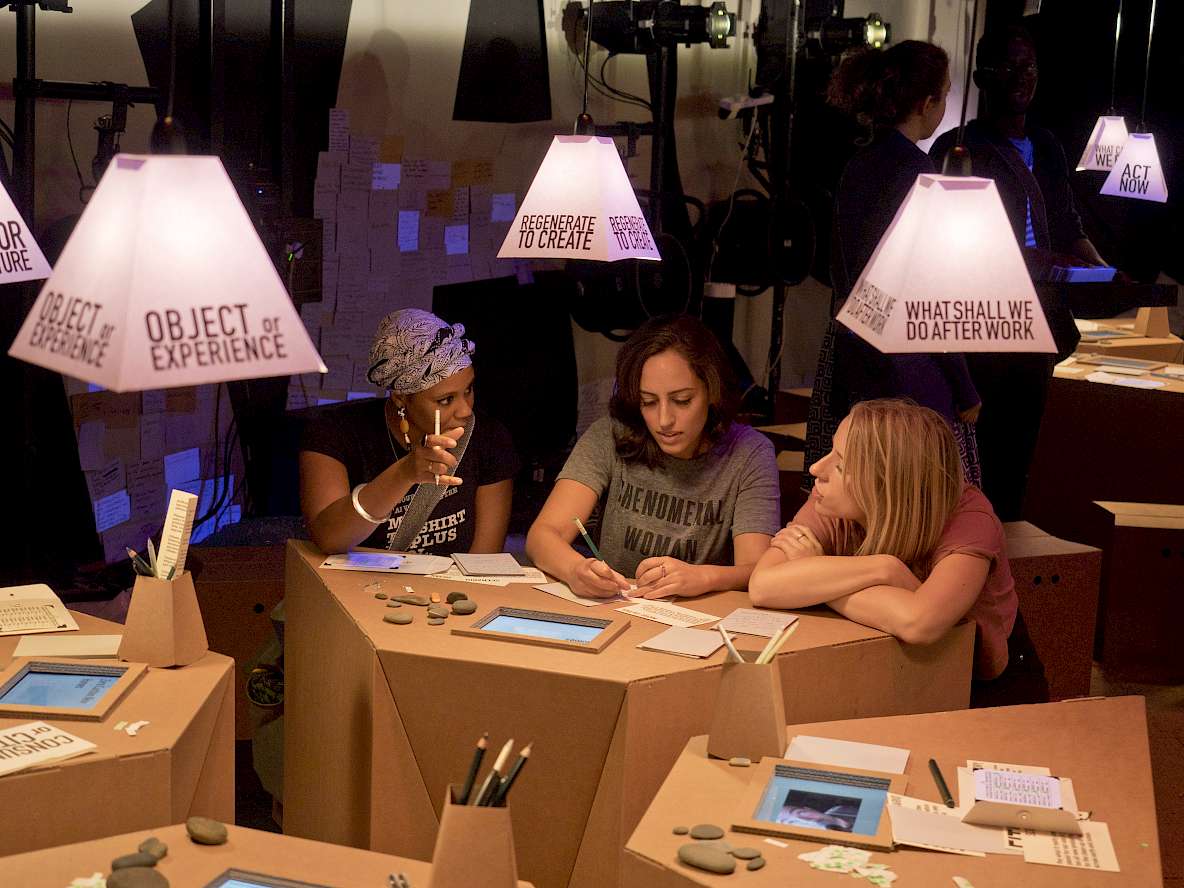
During your interactive sessions, you ask participants to write down their associations with the phenomenon of “high carbon culture” on small cards. What are your favourite answers that come to mind right now?
High carbon culture is astroturf.
High carbon culture is driving to the gym to get fit.
& some great ones from the workshop:
High Carbon Culture is using AI to search for times for a lower carbon life.
High Carbon Culture is how more and faster is always better.
High Carbon Culture is individualism (anti-community behaviour).
High Carbon Culture is when more sustainable options (travel, food) are less affordable than the more toxic ones.
High Carbon Culture is buying more stuff than you need to not pay for the delivery or for the discount.
What future awaits the small cards on which we were asked to write our ideas about what “high carbon culture” is, and then our visions for a better future?
We collect and keep the postcards, and use them in future installations, workshops and other events. So far we have examples from London, Cambridge, Oslo, Berlin, Hastings and now Prague too.
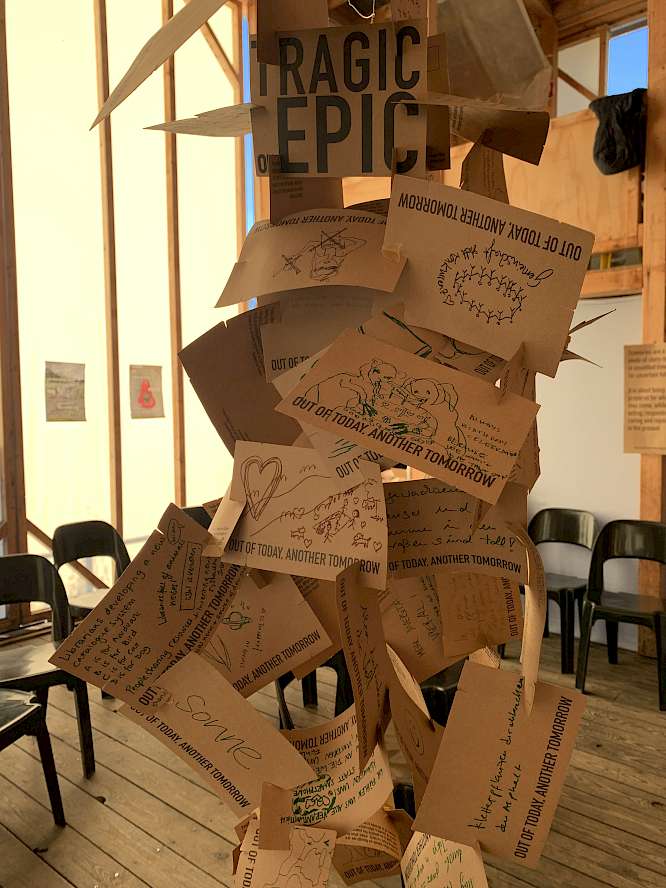
The last part of your workshop was full of speculation and humour, as we played a game in which we had to invent our future profession (because futurewill offer new fields of work). What other areas related to the climate crisis have inspired humour for you in the past?
Humour, joy, pleasure - these matter a lot. They make us feel more connected, more alive - and more able to countenance the pain in the conversations around climate crisis. We use therefore lots of improvisation games that focus on the pleasures of making things up, which also enables us to demonstrate resistance to moralising. For example in the cabaret show Love Letters To A Liveable Future one of our so-called ‘love letters’ took a game show format where the audience had to name ‘unsustainable pleasures’ ie. What they thought would be impossible to continue to do in a future of ecosocial care, and our improvisors, as game contestants, had to compete to come up with a plausible workaround. Both recognition of complicity in high carbon culture, and the feeling that actually the idea of sacrifice and missing out on pleasure was a myth, because our ingenuity always means we can find other ways, were highly enjoyable for audiences.
You make extensive use of digital applications in your participatory-based work. During the workshop, you spoke about paradoxes; for example, that the app used in the Transit project prevents people from using their phones in the usual ways, because the app is not supposed to stop during the event. How does the use of digital technologies align with criticism of “high-carbon culture”?
Climate dramaturgy is an ethos that engages with paradox and contradictions, which is the reality of living in what we call ‘high carbon culture’ - we often talk about both/and, rather than either/or. So it is very non-binary. Transit is a project that critically engages with digital technologies, whilst another of our projects, Ness: Displaced, focusses on nature resisting annilhilatory forces perpetrated by human behaviour. Both deploy app-based digital technologies in different ways - and Ness, in particular, invites you to switch off from personal digital engagement by turning off all notifications. While listening to Ness, you cannot use any other apps. Therefore listeners in fact put away their phones, and regular communications, and become immersed in the here and now of our sonic world,intermingled with the landscape they are walking through. Audience members have said this sharpens their senses and intensifies their relationship with the world around them.
A production is currently being staged in the Czech Republic (8 Billion People Are Burning by the group 8lidí) that reflects the circularity of current discussions about the climate crisis. The sauna is a metaphor for two extremes: the characters are either baking in the hot section or cooling off with ice-cold water. They are either suffocating in intense emotions or grounding themselves with rational arguments. Do you personally have any visions of how one might break out of such a loop? Do you think one is supposed to break out of it? How do you navigate through this loop?
I believe that this particular way of framing our relationship to climate crisis is fundamentally part of the problem, and the production you mention sounds like a very witty and insightful way of articulating it. There’s what feels to me to be a kind of ’victim mentality’ in high carbon culture that poses the issue as a kind of choice that is lose-lose, forcing us to choose between climate disaster and sacrifice of our familiar cultural practices/ ‘progress’/convenience. As though it were in the power of any of us to choose!
Indian novelist and theorist Amitav Ghosh speaks of us needing to find our way out of being trapped in an ‘individualising imaginary’. But to do so we’ve found, in our performance work, that we have to start somewhere else: not with how to ‘solve’ climate crisis but with acceptance of climate breakdown as a context, which demands deep cultural change towards more collaborative networked and relational ways of working, living, being and doing with each other and the living world around us. Rehearsing alternatives to the status quo therefore becomes not only about imagining otherwise for a not-yet reached (and currently unreachable) future, but practising for resilience, care and better relations in the now.
Strong emotions are often part of environmentally focused projects, with which you surely have a lot of practical experience. Has the way you think about the various stages of climate grief shifted over the years of your practice?
The grief has become more present - as the already-existing unbearable reality has become more apparent to those of us living in areas that are, as yet, relatively protected from the more extreme effects of climate crisis. I should say that I understand the term ‘climate crisis’ as a catch-all phrase to encompass the various kinds of genocidal and ecocidal harm done to the peoples and the living world across 400+ years of colonial capitalism. That is something that those of us living in the cultures that have directly or indirectly benefited from historic European white supremacy, must live with.
Grief is often related to something final, a known irreparable loss that must be somehow processed and accepted, at least enough to move on. With climate grief the repetition of loss - at a micro or macro level - is a constantly unfolding process of reencounter. In our performance work, we are learning to incorporate grief more explicitly, but our focus has always been more on imagining the better worlds that would become possible if there were to be transformative social and economic change - even in the context of the ongoing crisis. This in itself involves a kind of grieving for the fact that it could be otherwise, that this scale of damage and loss that we are currently living through, is neither inevitable nor necessary.
The website of the METIS collective, which you lead, states that one of your projects was a "rehearsal for climate crisis". How can one rehearse for climate crisis?
That project - in 2009/10 - happened at a moment when climate scepticism was very strong. The idea was that you could sidestep the question of whether or not someone believes in climate change - it seems quaint now that people not that long ago thought it was a question of belief - and instead simply to ask, if there were to be a polycrisis of interlinked emergencies caused by global warming and environmental degradation, how would you respond - what decisions would you make?
Since then though, the ideal of rehearsing alternatives to disaster narratives has become more and more central to my work - because I see art not as knowing any answers, but finding ways to ask questions. It’s about enlarging our conception of the possible, and how else to do that but to practise, explore, and rehearse the seemingly impossible? It comes back to the idea of finding ways out of the ‘individualising imaginary’. & for that it is essential we rehearse: fleshing out in the imagination the worlds we would love to bring into being.
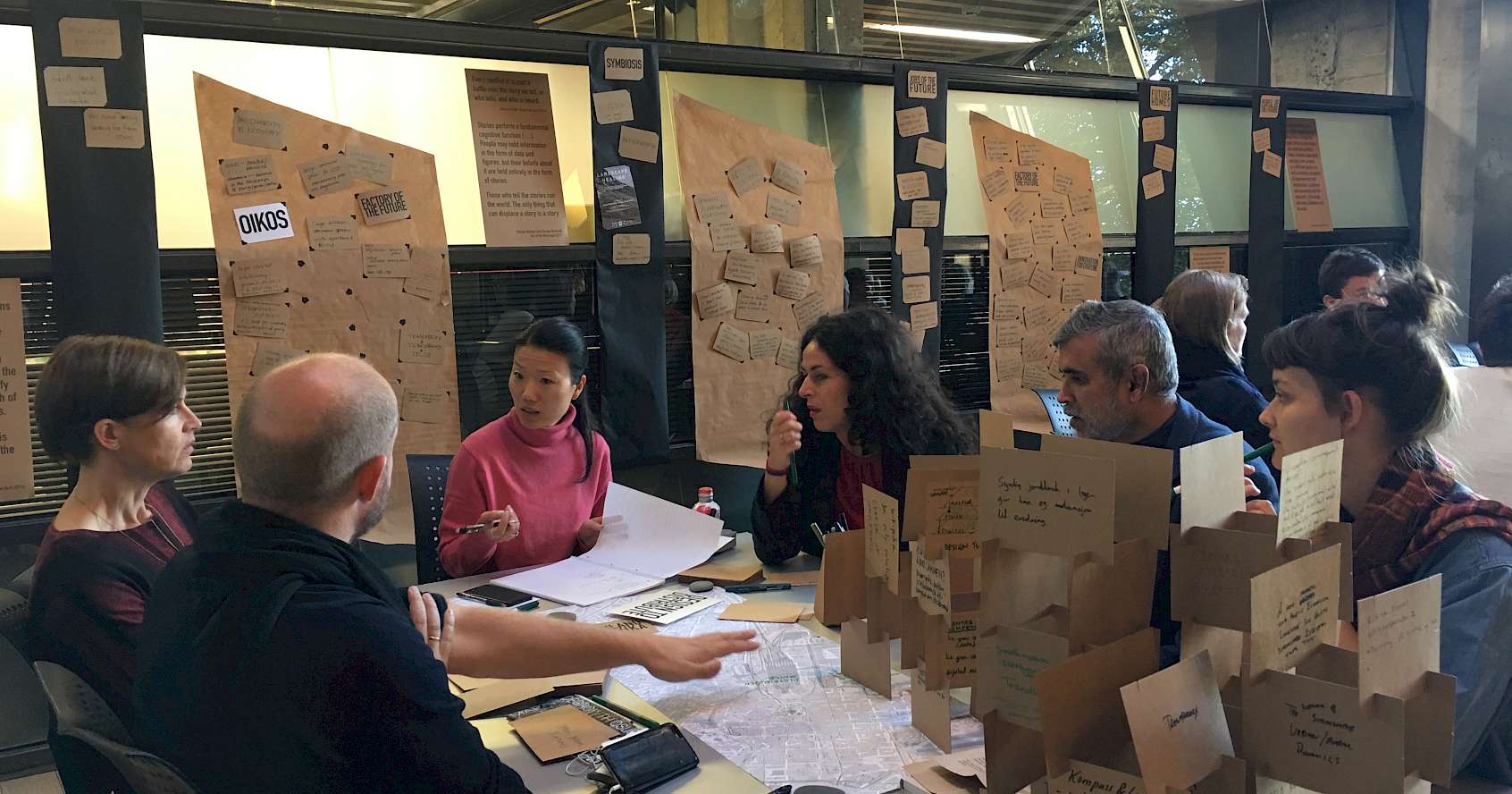
At the Prague workshop, our group discussed how a typical manifestation of “high carbon culture” in theatre is an excessive emphasis on professionalism. For example, there is a disconnect between artistic and operational theatre professions, which often prevents the theatre as a whole from thinking more ecologically. Do you observe this phenomenon in your theatre environment as well? (And how does it manifest itself?)
Absolutely! I do believe that a differentiation in roles is essential for delivering a production, but the split into ‘artistic’ and ‘technical’ can be problematic when people in those roles need to collaborate creatively, and practically, to find a way of realising their ideas in ways that minimise environmental harm – this is something that Paul Handley, Production and Technical Director at the National Theatre in London, often talks about. I also believe that bringing the ecological question into conversations as a challenge and demand, makes us think more sharply, more carefully, and more rigorously - we can’t any longer just execute the first idea. This is good for the art - not just for climate. When we listen to climate parameters, the demand to imagine interdependently, in collaboration with each other and the living world becomes part of the way the work is made. As long as there’s no one-size-fits-all solution that’s imposed, and the context of that particular work is attended to, my sense (in my own work and in the many conversations I’ve heard in climate dramaturgy workshops) is that recognising climate as a context is a powerful way to challenge conventional, familiar and outdated narratives.
Did anything come up during the discussion in Prague that surprised you or was new to you?
I was conscious of how aligned our questions and concerns are as theatre makers. I think we have a lot in common. I was interested to see the discussion around professionalism so precisely articulated. In the UK, I often see an idea of professionalism leading to the discounting of any context beyond the work – whether that’s specifically related to environmental responsibility, or ignoring/erasing collaborators’ lived experience. But people don’t talk about that so much as an issue. That’s one of the gaps climate dramaturgy is trying to repair – so it was heartening that it was at the centre of our discussions in the workshop.
A major theme in contemporary independent theatre culture is “forced” ecological behaviour due to a lack of funding. In the Czech independent theatre, for example, most set designs are made from used materials, since creative teams don’t have the money for new ones. Do you also have experience with some of the principles of environmentally responsible behaviour being applied in your circle more out of necessity than by free choice? If so, what kind?
There is often the argument that budget savings goes along with reduction in resource use - and there is a kind of truth to that, which can be highly valuable as long as the art leads, and minimalism is also driven by the desired aesthetic, alongside a focus on the actors’ performances. But too often, budget restrictions mean too little time to rehearse, and therefore last-minute ideas leading to succumbing to the just-in-time culture of ordering something on Amazon that is too cheap not to have exploitation built into the supply chain. Something being cheap actually means, in high carbon culture, that it’s probably damaging the environment more! So it’s how artists go about dealing with budget restrictions that matters.
I would say that financial restrictions also constrict the time for genuine collaboration - and that for me is as key to climate dramaturgy as being careful in use of resources. There is a long history of ever-worsening cuts to Arts funding in the UK, which are now at a level that brings very real existential risk, with many companies unable to survive any longer, and many freelancers having to leave the industry. This is masked by a successful commercial sector and the way that our commercial theatre is a conduit for actors and writer to move on to TV and film, globally via Netflix etc. So it looks wealthy when in fact at the grassroots, the training, the small-scale, the possibilities for innovation and experiment are being eviscerated. When theatre is under such pressure to deliver despite chronic underfunding, the argument that budget restrictions can be a positive for the climate starts to look like a justification for reducing financial support.
Conversely, in the UK, there is a tacid expectation – on the point of audiences as well as directors and designers – that career progression means leaving the economies of fringe theatre and tight budgets behind. Without careful thought, larger, grander designs tend to be more resource-heavy and made in a way that is bespoke rather than modular. Because of course everyone would like to work with large budgets! I’ve seen happen in the UK - that when directors and designers get to work in less financially constricted ways, the idea of ecologically-driven artistic rigour isn’t always sustained. I feel that we should be arguing for more support for environmentally conscious work that then goes into paying people for the additional time needed for the consideration and care that goes into that kind of creative practice.
I’d also like to find ways of resisting scarcity narratives, and attend to what is abundant: for example, there’s always an abundance of stories: and all we need is ingenuity to work out how to tell them. This resists a scarcity narrative, or that masochistic artists-must-suffer myth.
When we talk about strategies for financial support of sustainability: In the Czech context, there is no single central hub where, for example, the National Theatre could donate used set designs and exchange them with other theatres. What is the situation in your area? Do theatres have such reuse centres available?
The National Theatre, along with a network of other theatres, is working to set up such a storage hub, where they will store and catalogue materials and items for reuse.
Would you share with us your experiences with works of art (of any kind) that have recently caught your interest?
I recently saw two works by Klanghaus, who create audio-visual immersive events in intimate spaces that have a feel of a living room populated with life and history and love. The layered video effects are all-absorbing, and I’m now listening to the album of the show (or is it the show of the album?) on repeat. Their hugely affecting small scale show in the dark, Darkroom, explores our fears around climate apocalypse, though sound. What I valued most about it is that it coupled deep-felt aesthetic resonance with a carefully-held gentle conversation among all who had experienced it together. I’d have felt very bleak and isolated if I’d come away from the first part of the show, a sound installation, without that coming together after - the conversation contextualised the experience and I came away feeling hopeful - and reinvigorated by the power of art.
the interview was led by Barbora Etlíková