


Performative “Deep Pressures” in Times of Crisis (The First of a Series of Texts from the Santarcangelo Festival 2026)
In July, a festival focused on contemporary performing arts took place in Santarcangelo di Romagna, organized for the last time under the direction of curator Tomasz Kireńczuk. Over the course of five years, he framed the festival’s programming with overarching statements that related both to the presented works and to the current geopolitical situation. The first statement, “can you feel your own voice,” invited an exploration of the possibilities of self-expression; the second, titled “enough not enough,” focused on crossing boundaries and redefining relationships through contemporary theater and dance. In 2024, the program, with the motto “while we are here,” was intended to serve as a reflection on the value of live encounters in opposition to systemic isolation. The following “not yet” functioned directly as a political statement of resistance and hope amid multiple crises.
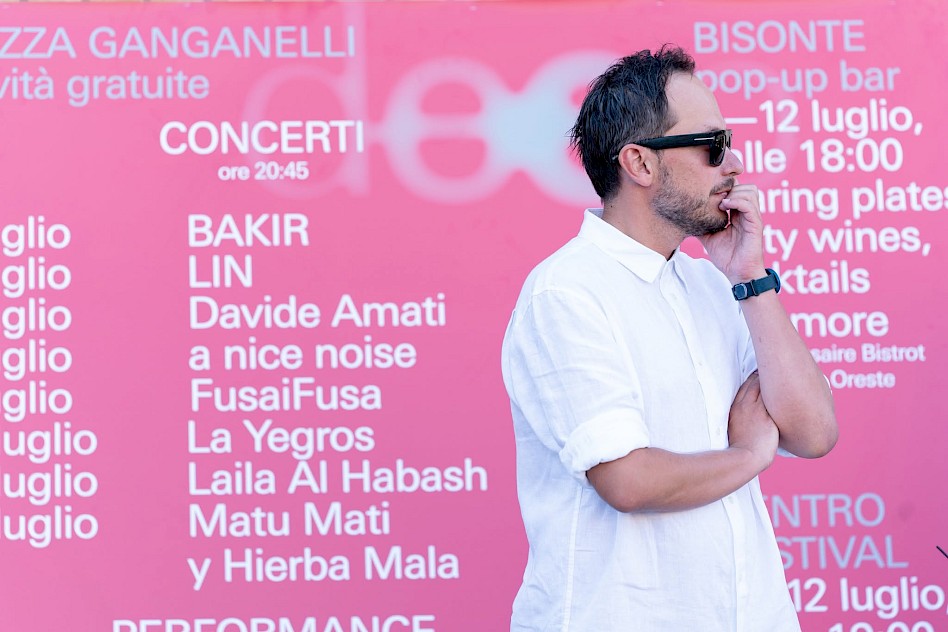
However, the curatorial statement for the most recent edition seems the most urgent: the theme “deep pressures” highlights that political pressure is not easing over time but, on the contrary, is intensifying. Tomasz Kireńczuk commented that “we are living through a historical moment marked by deep uncertainty: wars such as the one in Ukraine, genocides such as in Gaza, increasingly evident species extinctions and ecocides. We live in a world where economic and political pressure increasingly shapes how we relate to one another, where building walls and creating distance is often the most widely accepted systemic solution.” Yet it is not only specific vulnerable groups that face these “deep pressures,” but also seemingly privileged individuals in their everyday lives. Indeed, the planet itself is under unbearable pressure, with its ecosystems subjected to an ever-increasing burden. Secondly, however, the thematic focus also refers to the very nature of performing arts, which is capable of generating strong emotional pressure and delivering transformative experiences. It is precisely this aspect of this year’s program that I will focus on in my first text from the 56th edition of the Santarcangelo Festival.
Stanza (meaning “room” or “chamber”), a project straddling the line between performance and visual installation by the duo of choreographers and visual artists Gaetano Palermo and Michele Petrosino, explored this characteristic of performing arts through the format of one-on-one performance. The festival is developing this very approach through the blOOm network, which was established in 2025 in collaboration with five partner institutions1 and organizes artist residencies as well as public presentations of performances for a single audience member. Stanza deepens the already intimate nature of the viewing experience – as the title suggests – by inviting viewers directly into a hotel room. The performer (Michel Petrosino) occupies the room for eight hours a day, with visitors taking turns in twenty-minute intervals. He himself keeps his eyes closed the entire time, lying on the bed with his back to those who enter, leaving them uncertain as to how to approach this specific artwork.
The room is filled with objects that represent fragments of Petrosino’s “character’s” life. Unwashed plates and empty bottles litter the table, toiletries lie piled by the mirror above the sink and copious medications are scattered all over the place. Although examining personal belongings evokes a sense of intrusion, this activity holds far greater narrative potential than simply observing a performer who appears to be inactive. Despite my initial hesitation, I began to carefully examine the “mess” in the room myself. I read the names on the blister packs of medications – many of which I had not heard of before – and next to the nail clippers, I came across real human fingernails. Every detail seemed to point more directly to a state between illness, wakefulness, and sleep, deepening the sense of the situation’s fragility and the inappropriateness of observing it.
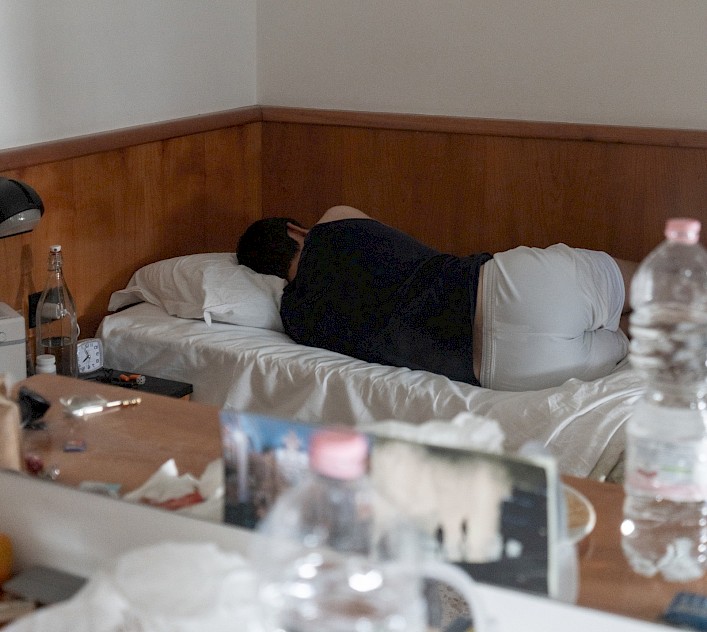
The whole experience gave me the impression of a very peculiar passage of time, which intensified toward the end of my stay, when the hands of the desk clock began to move faster than before. It was as if the hotel room were a separate world with its own rules. This is precisely how Victor Turner describes liminal experiences: as “moments in and out of time.”2 In doing so, he builds on the concept of liminality, which Arnold van Gennep introduced into anthropology. Turner views liminality (from the Latin limen, meaning threshold or boundary) as the threshold phase of rites of passage, in which the individual finds themselves in a state of “betwixt and between.”3 In the context of the performance Stanza, the hotel room becomes this liminal space, which detaches the viewer from their everyday social environment and introduces them to a state of precarious existence where common laws and conventions do not apply. In such a setting, it is therefore acceptable for the participant to go through another person’s personal belongings and observe them in a state of vulnerable inactivity.
Theater scholar Erika Fischer-Lichte adapts the originally anthropological concept of liminality specifically for the field of performing arts, describing the sensation facilitated by a performance as a liminal experience with the power to transform the subject undergoing it. While in rituals the liminal phase leads to a change in social status (for example, the transformation of a boy into a warrior or of an unmarried couple into spouses), in performing arts the transformation primarily concerns the participant’s perception of reality and inner state.4 According to Fischer-Lichte, a liminal experience occurs when the boundaries between opposites blur.5 In Stanza, the private and the public thus become intertwined. The viewer finds themselves on the threshold between intimacy and public exposure, with the hotel room functioning as an in-between space straddling the line between aesthetic experience and voyeurism.
This liminal situation can trigger a crisis in the audience – such as when a performer, with their back turned, plunges the incoming visitor into a state of uncertainty. Standard patterns of behavior do not apply under these conditions, and new ones have not yet been defined. That “initial shyness” and the subsequent examination of medications or fingernails represent a search for new ways to act in this “in-between world”. It was precisely these mechanisms that influenced the resulting sense of the experience’s transformative potential that I carried with me as I left the hotel room.
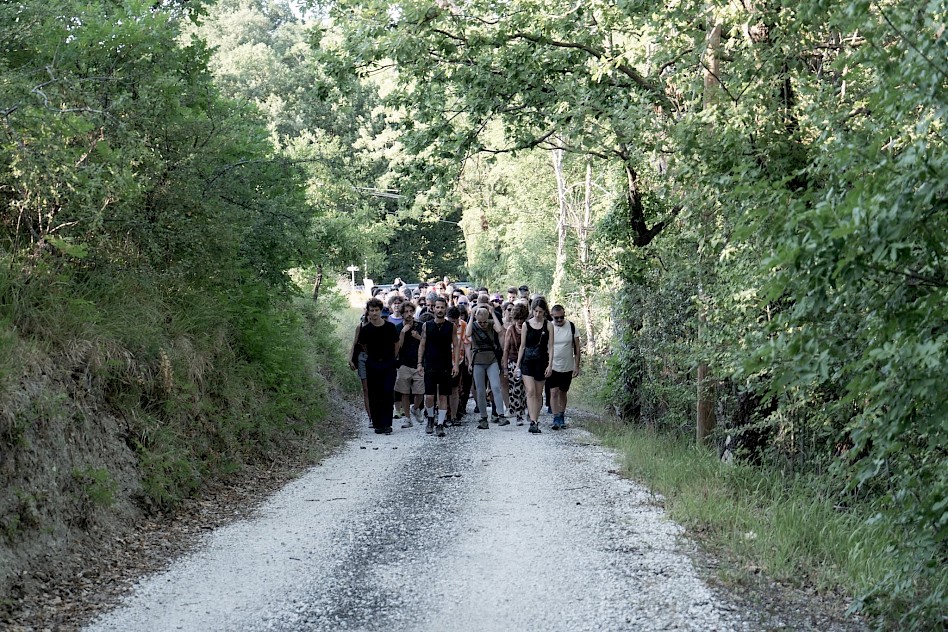
The site-specific performance Undersang by Harald Beharie, a Norwegian choreographer of Jamaican descent, took a different approach to creating a sense of “deep pressure”. Its indoor segment, which took place at a forest theater in Mondaino, was preceded by a forty-minute walk through the countryside.6 During the walk, after receiving instructions – which included, for example, a restriction on speaking throughout the entire journey – we walked in single file through the hilly Northern Italian countryside. Taking photos or otherwise sharing the experience with other participants was also forbidden, which deepened the introspective effect of the silent journey. The hike, which ended at the forest theater, was also quite physically demanding, especially in weather that exceeded the tolerable threshold of thirty degrees Celsius. While descending and ascending the heat-parched ground, it was necessary to constantly focus on the surroundings. In the midst of it all – amid the crumbling ground beneath our feet, the sweat, and our own thoughts – moans, bellows, and other animal-like sounds began to echo from the surroundings.
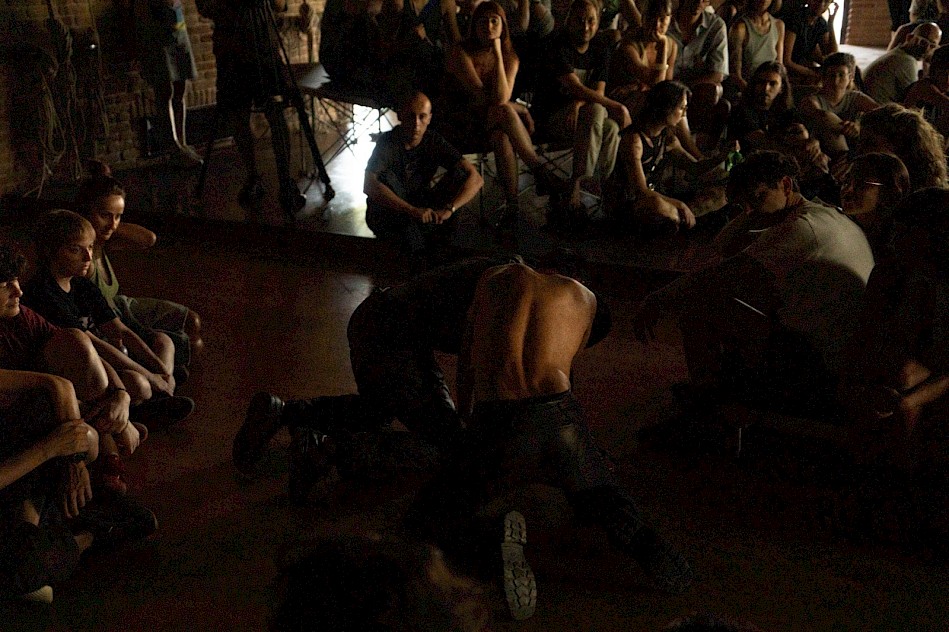
The artistic team followed up on these fleeting moments from the walk – during which, however, we saw no performers – once the audience had taken their seats in the forest theater. The performers (comprising Loan Ha, Carlisle Sienes, Jens Trinidad, Nosizwe Baqwa, Amie Mbye, Kéwè Bonono, and Harald Beharie for the time of the festival in Italy) emerged one by one from the forest to fill the space with gestures of intimacy and unabashed physicality. Loud breathing, repetitive movements combined with heavy panting, and intense eye contact often carried sexual undertones, through which the performance – much like Stanza – explored and pushed the boundaries of intimacy. The performers continued the choreography with increasing physical intensity until they reached a point of obvious exhaustion. At that moment, the internal component of the experience reconnected in my mind with the external as we, too, had reached the threshold of exhaustion while walking.
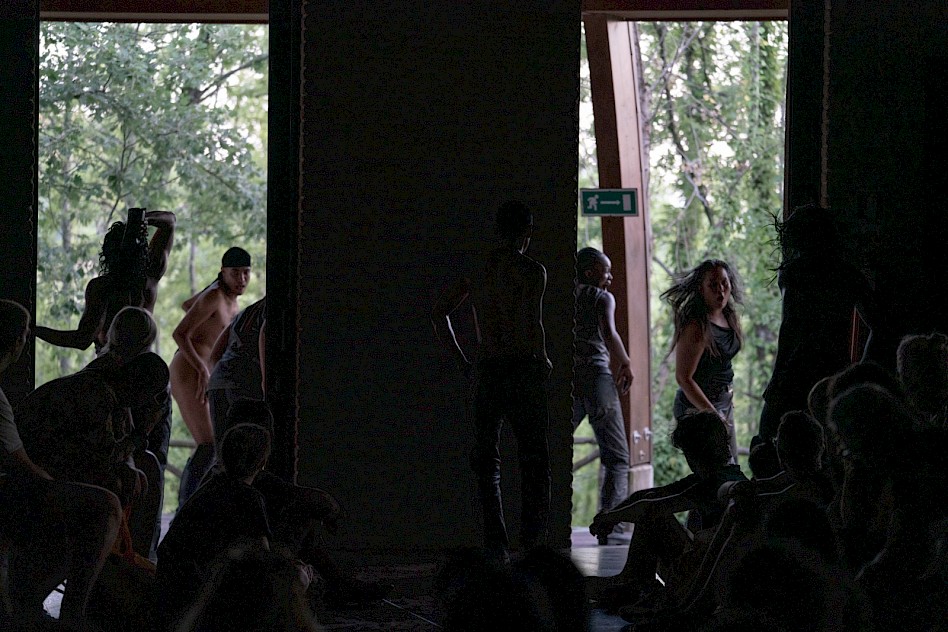
It is precisely this merging of the physical states of the audience and the performers that can be perceived as part of the liminal experience that began with our shared hike. The forty-minute walk through the countryside can be described as a “separation phase”. In the theory of rites of passage, this represents the first stage, during which the transformed individual detaches from their everyday life and becomes estranged from their usual social environment.7 The process of separation is realized in Undersang through several aspects. Instructions to limit speaking and the ban on the use of technology are, in this sense, not merely formal rules but tools for stripping the viewer of their “attributes of the past state”8. Detachment from a familiar environment is fundamental to entering a liminal space, while physical exertion, heat, and fatigue directly induce bodily transformation – changes in the viewer’s motor, physiological, and affective states. In this way, the entire event fulfills Turner’s vision of a rite of passage as a means of inner rebirth and the erasure of differences between individuals.
As projects such as Stanza and Undersang demonstrate, it is their ability to create a space “in between and in the middle” that serves as a direct response to the systemic isolation addressed by the festival’s curatorial framework. Erasing structural differences between individuals and disrupting previous social norms fosters the development of a new sensitivity to the presence of the other – one that values interpersonal encounters, diversity, closeness, and perhaps unexpected intimacy, from which we are increasingly distancing ourselves today. It is precisely this sensitivity that, in a context of multiple crises, serves as an essential tool for redefining relationships – one that can guide us through liminal experiences toward a radical sense of togetherness.
Kristýna Vinařová
[1] The Fondazione Armunia, the IRA Institute, Santarcangelo dei Teatri, Sardegna Teatro and Triennale Milano Teatro.
[2] TURNER, Victor. Průběh rituálu. Brno: Computer Press, 2004, p. 97. ISBN 80-722-6900-3. (The Ritual Process: Structure and Anti-Structure, Victor Turner)
[3] Ibid., p. 95.
[4] FISCHER-LICHTE, Erika. Estetika performativity. Mníšek pod Brdy: Na konári, 2011, p. 253. ISBN 978-80-904487-2-8. (The Transformative Power of Performance: A New Aesthetics, Erika Fischer-Lichte)
[5] Ibid., p. 255.
[6] L'arboreto – Teatro Dimora, a residential theater center and open-air nature park in the Emilia-Romagna region.
[7] FISCHER-LICHTE, Erika. Estetika performativity, p. 252.
[8] TURNER, Victor. The Ritual Process: Structure and Anti-Structure, p. 97.